

Innovative Digital
Asset and FX Liquidity Solutions
Delivering Institutional grade liquidity solutions
for next-gen Australian Companies
Partnered with Industry Leaders


Institutional-Grade Liquidity, Seamless Execution
Gain access to deep liquidity and tight pricing for digital assets and foreign exchange. Our advanced infrastructure ensures fast execution and reliable performance, empowering Australian companies and institutions via Direct OTC, UI or API to operate efficiently in global markets.
Trade Volume
Trading Pairs
Enabled Payments


Foreign Exchange Solutions
Our all-in-one FX solutions provide competitive rates, deep liquidity, and fast execution, helping businesses reduce costs and manage currency risk efficiently.
Speed & Efficiency – Instant settlements, reduced downtime with seamless treasury and payment management
Global Reach – settlements in multiple currencies across key markets. Our network is continuously expanding to service the market’s wide-ranging and continuously changing requirements.
Transparent Pricing – Market leading FX rates, no hidden fees.

DIGITAL ASSETS Trading
Blockchain technology is revolutionising global finance, we provide the secure, compliant, and efficient infrastructure you need to navigate the evolving landscape. Whether you're an institutional investor, a business integrating digital assets, or looking for seamless global transactions, our robust solutions empower you with speed, security, and regulatory confidence.
Multi-Asset Support – Seamless transactions across various digital assets, stablecoins, and fiat pairs.
Integration & Scalability – API-driven solutions for businesses integrating digital assets.
Transparent Pricing – Market leading rates, no hidden fees.

Why Neo-X?
Neo-X Financial Pty Ltd (AFSL 558430) provides wholesale digital asset and FX liquidity as principal: RFQ pricing in approximately 60 digital assets and 27 currencies, same-day settlement across those currencies, and a named dealer from 8am to 10pm AEST.

Licensed and audited
AFSL 558430, wholesale clients only. AUSTRAC reporting entity. Audited by Kelly & Partners; customer funds under custody held with Copper.

Principal pricing
Two-way RFQ on tickets of approximately $100k–$20m, priced against approximately 25 venues. Rate agreed before settlement.

One integration
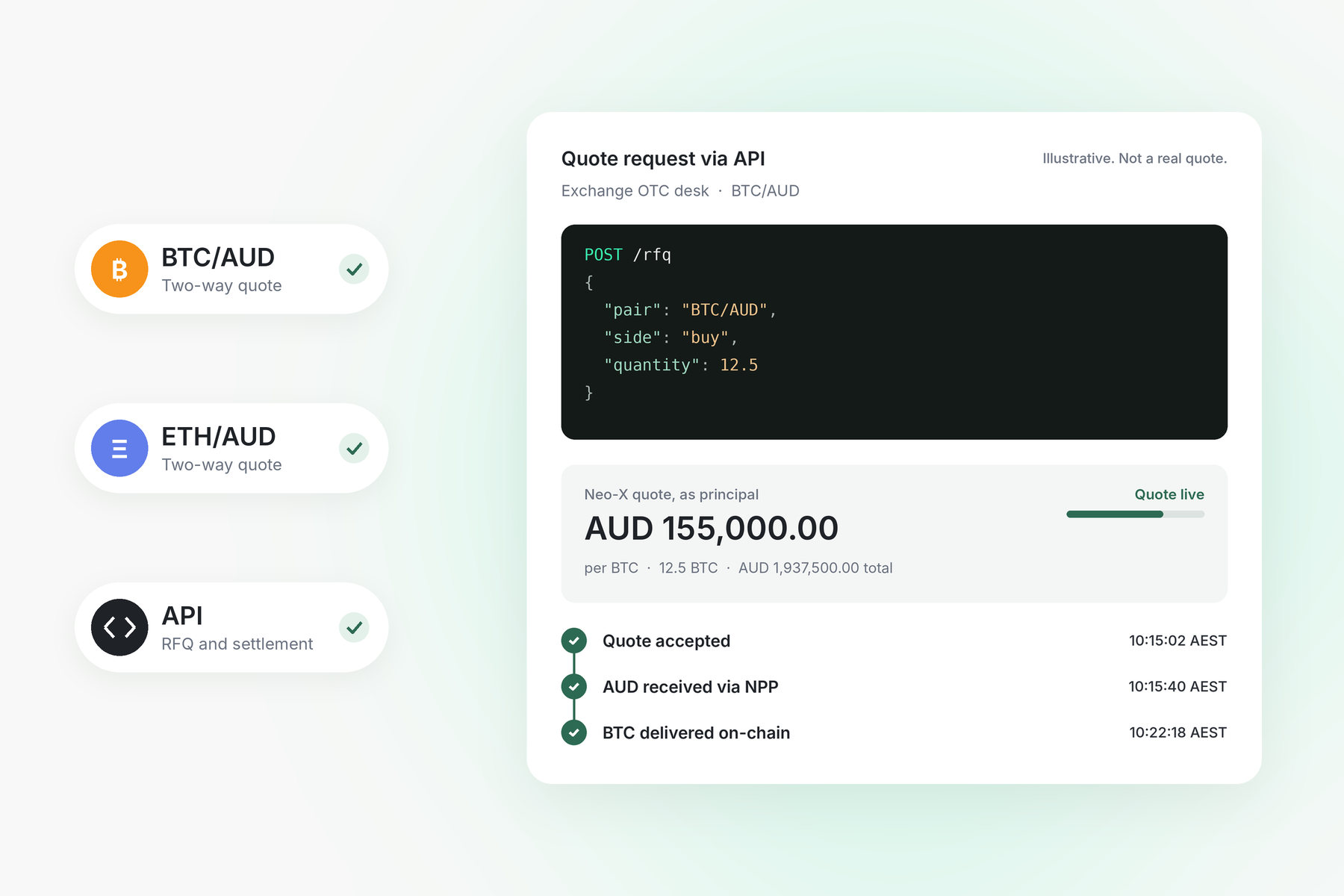
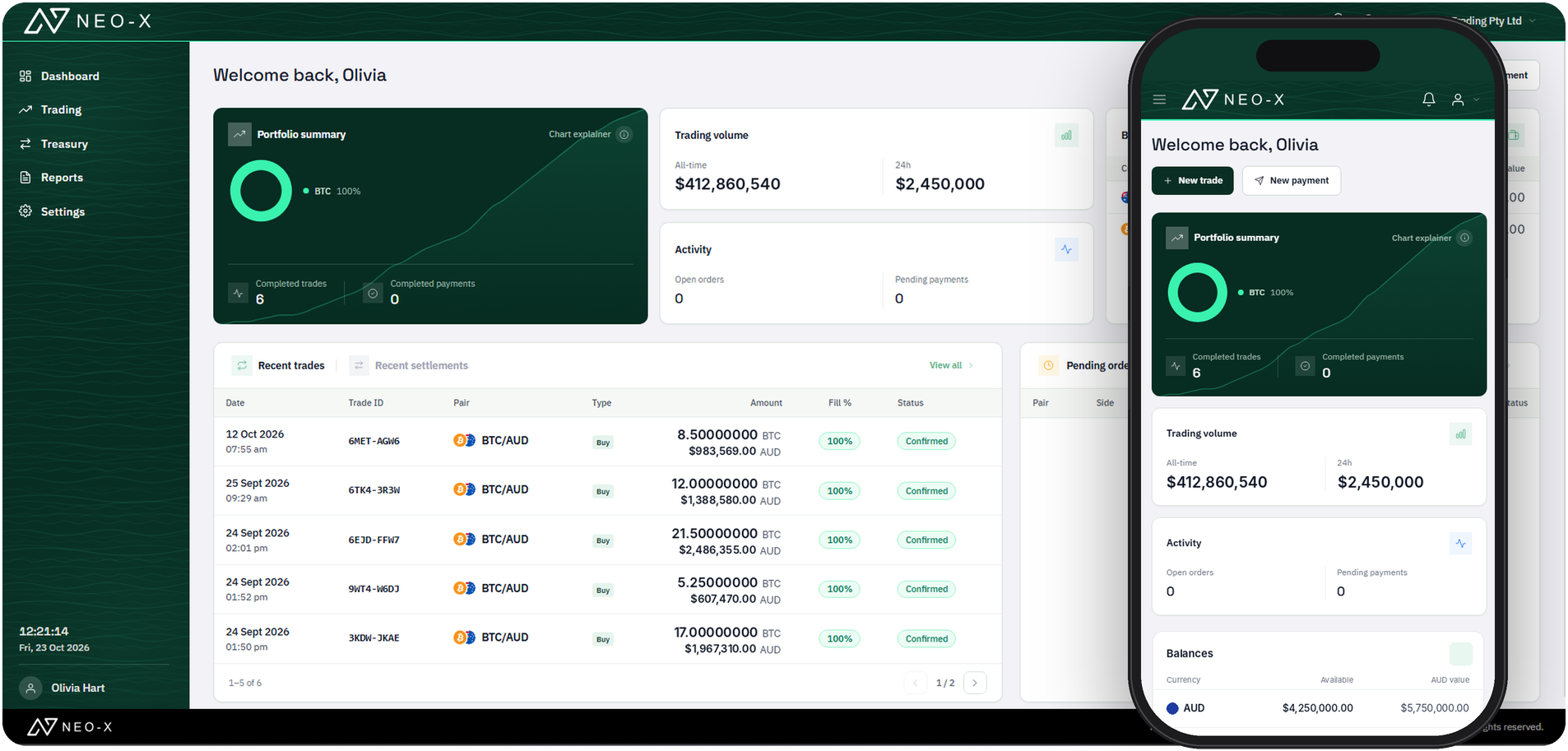
Trade by chat, web UI or API, with algorithmic execution and conditional orders available. AUD settles in real time over the NPP.

Named dealer
Desk 8am–10pm AEST with 24-hour support, and a named dealer for each client.
Our impact: real world case studies
Discover how our tailored solutions can enhance your business operations.



Experience seamless international fiat payments today.
Get started with a secure, fast, and compliant solution tailored for your needs.
Latest news

Neo-X Financial Granted Australian Financial Services Licence by ASIC
Neo-X Financial Pty Ltd (23 674 294 127), part of the Neo-X Group, has been granted an Australian Financial Services Licence by ASIC - for Wholesale Clients Only.
7 April 2026
Distributed ledger technology sits at the centre of one of the most consequential structural shifts in modern finance, evolving rapidly in real time.
We are pleased to announce to the market, that we have been granted an AFSL by ASIC. We're building the bridge between traditional financial systems and digital asset markets - delivering institutional-grade infrastructure that enables capital to move seamlessly across both environments within a strong regulatory framework.
"The AFSL reflects our unwavering commitment, not only to the standards required by the regulator, but also to those that we hold ourselves too internally. We welcome the new industry benchmark and look forward to broadening our service offering to a rapidly growing market."
Drew Kilroe - Chief Executive Officer
As the Australian market evolves, we remain focused on leading through change. We are well positioned to navigate the regulatory landscape and welcome a framework that enables constructive collaboration between industry and regulators.

OTC Trading
Neo-X will continue to expand its OTC offering. Providing liquidity solutions across more digital asset and fiat currency pairs. We will continue to refine our commercial offering, sharpening price, settlement speeds, and execution capabilities.
Trade Execution
Our execution model is channel agnostic. Clients access Neo-X through a combination of voice, chat, portal, or API best fits their workflow - execution quality, settlement standards, and service coverage are consistent across all of them.
Derivatives
Mitigate market exposures, secure cashflows, and create certainty through derivative strategies designed around the realities of our clients' businesses. Whether the exposure sits in cross-border payments, trading inventory, treasury operations, or digital asset positions, we structure forwards, swaps, and bespoke hedging products that match the underlying risk. The result is a hedging program that protects outcomes on terms that actually fit.

Non-Cash Payments
Our non-cash payment authorisation underpins how value moves through the Neo-X platform - across digital asset rails, fiat rails, and the cross-border flows that increasingly sit between them. We facilitate the settlement workflows that connect trade execution to client treasury, with controls embedded at every step. Every transaction running through our institutional-grade compliance infrastructure.
Client funds are held under our basic deposit authorisation while transactions are arranged and finalised, ensuring capital sits within a regulated framework throughout the entire trade lifecycle. For wholesale clients managing real flows - between counterparties, across borders, and across asset classes - non-cash payment capability is the difference between a desk that quotes prices and a counterparty that completes transactions. We've built the latter.

Neo-X Financial Pty Ltd (AFSL 558430) has been granted an Australian Financial Services Licence, available only to wholesale clients as per Sections 761GA and 708(10) of the Corporations Act 2001 (Cth) (Sophisticated / Wholesale Client). To serve these products, Neochain Pty Ltd (CAR No. 001320366) and NeoFX Pty Ltd (CAR No. 001320367) have been appointed as Corporate Authorised Representatives. We do not provide financial products or services to retail clients.

Market Update: 29 October 2026
Thursday 29 October 2026, 10:00 AEDT. Commentary from the Neo-X OTC desk and the Neo-X derivatives desk. Wholesale clients only. Prices are from public sources and are illustrative, not quotes.

Gold, oil and the US curve set the tone: WTI settled at US$102.78 (+2.9%) and the 10-year is back above 5% while the 2-year eased after the hold, so the curve steepened. In FX the dollar firmed against the euro and sterling into the Fed while AUD/USD finished the week where it started. In digital assets bitcoin held its US$80,000 to 82,000 range (−3.3% on the week) and ether underperformed; among the desk's active names HYPE was flat, XLM and SUI were weaker, and tokenised gold tracked spot lower.
Markets
Bitcoin held its range through the Fed. Spot printed an intraday high of US$81,687 early Wednesday US time, slipped below US$80,400 into the decision and traded near US$81,000 after it; at 10:00 AEDT it is US$81,265. The 90-day high of US$86,594 (20 September) has been rejected twice and October has been a grind lower from US$86,500, but the US$80,000 to 82,000 band has now absorbed a weekend dip, the CPI and the FOMC. Coinglass data put Wednesday's bitcoin liquidations near US$58 million, of which more than US$46 million were shorts, and total crypto liquidations above US$167 million with about US$110 million from shorts, so the positioning squeezed by the Fed was short, not long. Galaxy's Alex Thorn has argued the bear market ended in June below US$58,000 and cites a daily close above US$82,500 as the level that would confirm the recovery. ETF flows remain the missing piece: spot bitcoin ETFs took in US$110 million on Monday, but October as a whole has seen more than US$1 billion leave bitcoin and ether ETFs.

Ether has underperformed; a few alts have not. ETH/USD is down 12.1% over 30 days against 2.6% for bitcoin, and the ETH/BTC ratio has fallen from about 0.032 at the start of October to 0.029. Against that, Zcash rose about 8% to US$1,320 and HYPE about 5% to US$81 on Wednesday, with XRP and DOGE up around 3% and SOL 2%; the alt complex is selective rather than broad.
Stablecoin supply is contracting at the margin. Total stablecoin capitalisation was US$300.4 billion at 25 October (DefiLlama), down US$12.7 billion from the May peak. USDT is US$182.4 billion (60.7% share), down US$1.3 billion over 30 days; USDC is US$71.7 billion, down US$4.7 billion over 30 days. Less stablecoin on the sidelines means less immediate buying capacity, and it is consistent with the ETF outflows.
Equities, oil and the curve. US equities closed modestly higher after the Fed, with the S&P 500 at 7,744 and the Nasdaq Composite at 26,550; the ASX 200 gave up a near-1% gain after the CPI to close flat at about 8,847, with energy the drag. December WTI settled at US$102.78 (+2.9%) and Brent at US$115.32, and crude is the thread that runs through both the Australian fuel component and the Fed's inflation language. The US 10-year closed back above 5% at 5.02% while the 2-year eased to 4.71%, so the curve steepened on the hold. Gold slipped 0.5% to about US$4,038. Big-tech earnings land Wednesday and Thursday US time.
The Australian dollar. AUD/USD reached about 0.7045 mid-morning Wednesday on the CPI, settled near 0.703 by the Sydney close and is 0.7033 this morning after a Fed hold that was fully priced. The pair fell from 0.7225 in mid-September to 0.6940 by early October as the US dollar firmed on Fed hike pricing, and has recovered as RBA hike pricing caught up; with both central banks now leaning the same way, the rate differential is doing less work and the pair has gone quiet. On the crosses AUD/NZD is up 1.4% on the week to 1.2529, with the New Zealand dollar the weakest G10 currency on Wednesday, while EUR/USD and GBP/USD are both down about 0.9% on the week as the dollar firmed into the Fed.

Politics and policy
Australia: a November hike is now the base case. The ABS September CPI, released Wednesday, showed headline inflation at 4.3% year on year (up from 4.0% in August) and 1.3% for the September quarter. The trimmed mean rose 1.0% in the quarter and 3.6% over the year, in line with bank forecasts but above the RBA's own August forecast of 0.8% for the quarter. Housing (+5.2%, with electricity +12.8% as Commonwealth rebates expired) and transport (+8.7%, with automotive fuel +23.6% on oil) were the largest contributors. Market pricing for a hike on 3 November moved from about 60% before the release to 79%, and was quoted near 90% in the immediate aftermath. CBA switched its call from hold to a 25 basis point "insurance hike"; ANZ said the data "cements" a November move; Westpac already had a hike and does not expect more beyond it. Deputy Governor Hauser said the numbers were broadly as expected but "too high". The cash rate is 4.60% after four hikes this year, the last on 29 September. Unemployment at 4.7%, a five-year high, remains the argument for stopping after one.
United States: a hawkish hold. The FOMC held the funds rate at 3.75 to 4.00% at 5:00am AEDT this morning, as about 90% of the market expected. The vote was split: Governor Lisa Cook and Cleveland Fed President Beth Hammack dissented in favour of a 25 basis point hike. The statement kept "inflation remains elevated" and said the committee "will deliver price stability". Chair Warsh said capital expenditure strength is "not just strong, but it is broadening", said politics and the midterms were not discussed, and announced that from 2027 one of the eight annual meetings will be a strategy session with no rate vote, rising to two in 2028. Fed funds futures after the decision point to a strong possibility of a hike at the 8 to 9 December meeting, with one or two more priced for 2027. For AUD/USD and bitcoin the message is that the December hike debate is live, but the market had already priced most of it.
US midterms, 3 November. Polls and prediction markets have favoured Democrats to take the House, with the Senate close. For digital asset policy the relevant point is that the CLARITY Act (market structure) failed a Senate cloture vote 49 to 50 on 15 September and is widely considered dead for this Congress, so the rule-making has moved to the agencies: the SEC's proposed Regulation Crypto Assets closed for comment on 20 October, and the CFTC's crypto market rule is at OIRA review ahead of a formal proposal. Fairshake has committed US$30 million against Sherrod Brown's Ohio Senate bid. A bipartisan crypto tax bill passed House Ways and Means in September and now has a Senate version.
Australia's own regime is further along. The Corporations Amendment (Digital Assets Framework) Act commences 9 April 2027 and brings digital asset platforms and tokenised custody platforms under the AFSL regime, and the expanded AUSTRAC virtual asset service provider obligations, including the travel rule, have applied since 1 July 2026. Neo-X Financial already operates under AFSL 558430 and has been an AUSTRAC reporting entity since 2022.
What we are watching
- Thu and Fri, US time: big-tech earnings. Crypto has traded with semiconductors and AI capex in October; a weak print would test US$80,000 again, a strong one puts Galaxy's US$82,500 daily-close level in reach.
- Fri 30 Oct, US: any first reading of how the dissents reprice December in fed funds futures; a move above 70% for a December hike would firm the US dollar.
- Sat 31 Oct: Celestia unlock of 5.58 million TIA.
- Tue 3 Nov, 2:30pm AEDT: RBA decision and Statement on Monetary Policy with new forecasts. A 25 basis point hike to 4.85% is about 80% priced; the forecasts and whether the board signals one-and-done will matter more than the move.
- Tue 3 Nov (US), results Wed 4 Nov AEDT: US midterms. Control of the Senate determines whether a revived market-structure bill is possible in 2027.
- Daily: US spot bitcoin ETF flows (Farside). Three consecutive inflow days would be the first since early October.
- Fri 25 Dec expiry: the US$72,000 bitcoin put remains the most traded option; open interest at that strike is the market's stated downside reference
OTC desk view
USDT/USD. Taking Binance USDC/USDT as the reference and inverting it, USDT has traded below par every day since 6 October, between 7 and 14 basis points under the dollar for the past fortnight; it closed at 0.9991 on Wednesday (8 basis points under) after a 30-day low of 14 basis points under on Monday. That discount is small in absolute terms but it is persistent, and it is the part of an AUD/USDT price that is not AUD/USD. On Wednesday the Kraken USDT/AUD close of 1.4154 sat about 45 basis points below the ECB USD/AUD rate of 1.4219, so the AUD leg was doing most of the work; that gap reflects thin AUD-pair liquidity around the CPI and Fed rather than anything about tether. For a client converting AUD into USDT the basis is a small tailwind; for a client selling USDT back into AUD it is a small cost. Our quotes combine the two legs into one all-in AUD/USDT rate, so the basis shows up in the rate rather than as a separate fee.

Flow. Client flow over the past week has been steady bitcoin accumulation, with off-ramping back into AUD running at a broadly balanced pace against it, so the desk has been two-way in AUD/BTC rather than one-directional. Altcoin activity has been quieter than usual conditions; the exceptions have been HYPE, XLM, SUI and XAUT (tokenised gold), where client interest has stood out against an otherwise subdued book. These are observations of what the desk has seen, not a view on where prices go next.
Liquidity and settlement. The Fed window has passed; the next event is the RBA at 2:30pm AEDT Tuesday, which falls inside Sydney hours when AUD depth is at its best, so there is no need to pre-position for liquidity reasons. Depth in AUD pairs remains thinnest between the US close and the Sydney open. Clients with size to move around the RBA can secure a rate and settle within the trading facility either side of the announcement. Same-day AUD settlement via NPP and on-chain USDT settlement are unchanged.
Derivatives desk view
Bitcoin options. The 25-delta put-call skew is positive across tenors, meaning puts cost more than equidistant calls, and the US$72,000 put expiring 25 December has been the most traded contract for several sessions. Wednesday's liquidations were two-thirds shorts, which says the leveraged futures book had leaned short into the Fed and was squeezed on a non-event. With the decision out of the way, front-end implied volatility should bleed unless earnings surprise; that is the configuration in which collars are cheapest for a holder, because the put the client buys is still bid on skew while the call the client sells is bid on the US$82,500 breakout debate.
Illustrative structure, not a quote: a two-month BTC collar. A holder of bitcoin at spot US$81,250 buys a US$72,000 put and sells a US$90,000 call to 25 December, structured for zero net premium (zero-cost means zero premium paid up front, not zero risk). At expiry: below US$72,000 the holder is protected at US$72,000 and gives up nothing further; between US$72,000 and US$90,000 the holder keeps the full move in either direction; above US$90,000 the holder's gains are capped at US$90,000 and the upside beyond that is forgone. If bitcoin is at US$95,000 at expiry the holder receives US$90,000 for the capped portion; if it is at US$65,000 the holder receives US$72,000. Strikes, dates and the zero-premium pairing are chosen for illustration; live strikes depend on the volatility surface at the time of the quote, and margin is called on mark-to-market moves over the life of the trade.
AUD/USD. With the Fed done and the RBA on 3 November, one-week AUD/USD implied volatility is the expensive part of the curve and the Fed premium has come out of it. Clients with a known USD payable or receivable in the next fortnight have been asking about forwards and collars that straddle both meetings. The same symmetry applies: a collar removes the outcomes beyond the strikes in both directions.
What would change the view. An RBA that hikes on 3 November and signals more would lift AUD/USD towards the 0.7225 September high and widen the rate differential against a Fed that paused. A hold would do the opposite and would surprise an 80% priced market. For bitcoin, a daily close above US$82,500 on resumed ETF inflows would flatten the put skew; a break of US$80,000 on volume with outflows resuming puts the US$72,000 strike in play and makes protection materially more expensive to buy after the fact.
Neo-X Financial Pty Ltd holds AFSL 558430. Client-facing services are provided by Neochain Pty Ltd, CAR 001320366. Wholesale clients only, as defined in sections 761G, 761GA and 708 of the Corporations Act 2001 (Cth). Neo-X acts as principal, makes markets, hedges across listed and OTC venues and its own inventory, and may hold positions in the assets it quotes. Derivatives carry risk, including loss exceeding any premium received and margin calls. Market data from Kraken, Binance, the ECB via Frankfurter, Trading Economics, Farside, DefiLlama, Glassnode, CoinDesk, Coinglass, the ABS and the RBA; figures are approximate and are not quotes. Nothing in this update is financial product advice or a recommendation to trade. Contact sales@neox.au or (02) 9136 0264.

OTC Derivatives at Neo-X
Neo-X's OTC derivatives desk has been live since March 2026, operating under AFSL 558430 for wholesale clients only.
What the desk does
The desk prices and trades FX and cryptocurrency derivatives directly, off-exchange and as principal. Each contract is sized and dated to the client's specific requirements: notional, tenor, strike, settlement currency and settlement method are agreed per trade rather than taken from a listed contract. Underlyings are bitcoin, other digital assets in the OTC coverage list, AUD crosses and other foreign exchange pairs.
Structures
Linear. Forwards, swaps and cross-currency swaps. A fixed price in both directions, with mark-to-market valuations over the life of the trade.
Vanilla options. European, American and Asian puts and calls. Premium paid is lost if the option expires out of the money; selling options creates an open-ended obligation.
Structured hedging. Collars, spreads, seagulls and participators. Lower or zero premium in exchange for capped upside or partial protection.
Yield. Covered calls, iron condors, digitals, sharkfins, knock-outs and target redemption forwards. Losses in an adverse scenario can exceed the premium, and are uncapped on some structures.
Bespoke. Combinations of the above, including BTC-collateralised FX structures.
FX: fixing the cost of a US dollar payable
A Sydney importing company has US$5 million to pay in three months. With AUD/USD at 0.6600 and the three-month forward at 0.6620, the forward fixes the AUD cost at A$7.55 million whatever the rate does. The zero-cost collar leaves the cost floating between a floor at 0.6400 and a cap at 0.6900: protected if the Australian dollar falls below the floor, but giving up the benefit if it rises above the cap. Lower on the chart is cheaper.

Bitcoin: four ways to shape a holding
A holder of 400 BTC with spot at US$60,000 and the forward at US$66,000. The collar sets a floor and a cap at zero premium. The forward plus a bought call fixes the price and buys the upside back above US$72,000, for a premium. The participator fixes half the position and leaves the rest open. The covered call receives a premium today and gives up gains above US$70,000, with no protection below. Higher on the chart is a higher value for the holding.

Illustrative payoffs at expiry, before margin and funding. Strikes, rates and sizes are chosen for clarity and are not quotes. Green: better than unhedged. Red: worse than unhedged.
Why clients trade these structures
To fix or bound a cash flow they already know is coming. A miner selling next quarter's production, a payments company with a US dollar payable due in ninety days, a fund with a redemption to meet in AUD. The exposure exists whether or not it is hedged; a forward or collar replaces an unknown rate with a known one, or with a known range, so the budget holds whatever spot does in between.
To change the shape of a holding without selling it. A treasury or family office that wants to keep its bitcoin, or its foreign-currency balance, but not its full exposure to the price. A collar sets a floor and a cap on the position; a covered call receives a premium today in exchange for giving up gains above the strike. The asset stays where it is, and the return profile changes.
In both cases the client is choosing which outcomes to give up in order to remove others. The desk prices the trade-off; it does not advise on whether to take it.
Execution and margin
Pricing is on request by chat, UI or API. The desk returns a firm, dealable quote with strikes, premium or forward rate, and settlement terms; on acceptance a confirmation issues under the client agreement. Margin is posted in any fiat currency or crypto asset, with variation margin on mark-to-market moves. Crypto posted as margin is itself marked to market. Positions can be unwound or restructured at market before expiry, which realises the gain or loss at that point.
Settlement
Settlement runs on the same rails as the OTC spot desk: same-day in 27 fiat currencies through the Neo-X Global Settlement Network, or on-chain to the client's nominated address.
Who it is for
Wholesale clients only, under sections 761G and 761GA of the Corporations Act 2001 (Cth): corporate and Web3 treasuries, payments companies and MSBs, family offices, fund managers, exchanges, dealers and brokers. Neo-X does not give personal advice or assess suitability. The desk shows the payoff under adverse and favourable scenarios before dealing, and the client decides.
Access
Existing OTC clients can request derivatives pricing from the desk directly - subject to suitability approval. New clients email sales@neox.au or call (02) 9136 0264. Desk hours 8am to 10pm AEST, with 24-hour support.
Neo-X Financial Pty Ltd holds AFSL 558430. Client-facing services are provided by Neochain Pty Ltd, CAR 001320366. Wholesale clients only. Neo-X acts as principal, makes markets, hedges across listed and OTC venues and its own inventory, and may hold positions in the assets it quotes. Derivatives carry risk, including loss exceeding any premium received and margin calls. Nothing on this page is financial product advice.

On/Off-ramping In Australia
Crypto on-ramping is the process of converting fiat, meaning government-issued currency such as AUD or USD, into cryptocurrency. Conversely, off-ramping is selling cryptocurrency for fiat. Investment and speculation aside, businesses use blockchain rails for near-real-time settlement that runs 24 hours a day, lower transfer costs on many corridors, and programmable cross-border payments. Increasingly, Australian businesses are building cryptocurrency transfers into their payment and treasury workflows: importers on-ramp capital to fund overseas suppliers, payment companies use stablecoins for near-real-time global remittance, and fund managers trade and settle outside banking hours. One metric we watch: stablecoins moving across borders rose 77.5%, from US$124.2 billion to US$220.3 billion, in the year to June 2026, with monthly value more than doubling from US$11 billion in January 2025 to US$24 billion in June 2026. Chainalysis describes this as a conservative on-chain estimate.
Source: Chainalysis, 2026 Global Crypto Adoption Index.
USDT/AUD: the Pair Most Australian Businesses Ramp Through
USDT against the Australian dollar is the most traded pair for on/off-ramping. USDT is the largest stablecoin measured by supply, roughly US$187 billion in circulation as at June 2026, about 59% of the total stablecoin market (DefiLlama), a first preference for offshore suppliers, exchanges and payment counterparties.
Two things make USDT/AUD different from a plain FX trade. First, the price has two parts: the AUD/USD rate and the USDT/USD basis, because USDT trades at its own value against the dollar, usually within a few basis points of one. A USDT/AUD quote reflects both at the moment it is given. Second, the two legs move on different rails: the AUD leg settles through the Australian banking system, and the USDT leg settles on-chain on the network the client nominates, so the speed of the slower leg sets the speed of the trade.
Liquidity in USDT/AUD can be uneven. Exchange order books for the pair are thin relative to USDT/USD, so an order of a few hundred thousand dollars can walk the book. Neo-X prices USDT/AUD in one firm, all-in rate for tickets from A$100,000 to A$20 million, in either direction, which is the reason the pair sits at the centre of how Neo-X on-and-off-ramps for wholesale clients.

On/off-ramping: Exchange Vs. OTC Desk
An exchange order book and an over-the-counter (OTC) desk solve different problems. The order book suits small, frequent conversions where the business wants to see the market and work an order. The OTC desk suits larger trades, where the business wants one price, no slippage and delivery straight to its bank account or wallet; speed and price are the primary drivers.
What to Consider When Choosing an OTC Provider in Australia
Licensing and entity Which legal entity you are contracting with, what licence it holds and what that licence authorises. In Australia, an Australian Financial Services Licence and an AUSTRAC registration as a virtual asset service provider are different things: the first is a financial services authorisation with conduct, competence and compensation obligations; the second is an anti-money-laundering registration. Both can be checked on the ASIC and AUSTRAC public registers, and the entity named on the register should match the entity you are facing. Licensing and AUSTRAC registration should be treated as the minimum requirement when deciding who to trade with.
Pricing method Is the quote all-in, meaning the price you accept is the price you pay, with no commission, settlement or custody fee added afterwards.
Size & Settlement What is the minimum and maximum single trade size in the specific fiat or cryptocurrency you are buying or selling. Different OTC desks have access to different liquidity, and a desk may be deep in one set of currencies and thin in others; checking this before onboarding saves time. Ask what settlement rails the desk uses, whether it has access to NPP (AUD), FedNow (USD) and SEPA Instant (EUR), and which cryptocurrency networks are available for settlement. Banking and settlement infrastructure determines how fast the other side of your trade arrives.
Pre-funding Does the provider require funds on account before the price is secured, or does it offer a trading or settlement facility so the rate is locked first.
Custody Who the provider uses for custody, whether the custodian is licensed or regulated, and in which jurisdiction.
Access and Hours How you request a price, whether by chat, web interface or API; when the desk is staffed; and what support exists outside those hours for settlement or operational issues.

How to On/Off-ramp with Neo-X
Licensing and Entity Neo-X Financial Pty Ltd holds Australian Financial Services Licence 558430, which authorises it to provide and make a market in non-cash payment facilities, basic deposit products, derivatives and FX contracts for wholesale clients. Client-facing services are provided by Neochain Pty Ltd, Corporate Authorised Representative 001320366. Neo-X has been an AUSTRAC reporting entity since 2022 and is a registered virtual asset service provider. Both entities can be checked on the ASIC and AUSTRAC public registers, and they are the entities named on the client agreement.
Pricing Method All-in. Neo-X returns one request-for-quote price built from approximately 25 venues (exchanges, banks and market makers), firm for the quote window, and the price the client accepts is the price the client pays. There is no commission, settlement fee or custody fee added on spot tickets; Neo-X makes money via the the spread.
Size and Settlement Approximately A$100,000 to A$20 million per ticket, in either direction, across approximately 60 digital assets and 27 fiat currencies. AUD/USDT is the most traded pair and the deepest; USDC and AUD-denominated stablecoins are quoted on the same terms. Fiat settles same day across 27 currencies through the Neo-X Global Settlement Network, with access to NPP for AUD, FedNow for USD and SEPA Instant for EUR. Stablecoins settle on-chain to the client’s nominated address. Approximately 95% of Neo-X trades settle within one hour and 99% within two hours (as at October 2026).
Pre-funding Not required. Every onboarded client has an A$1 million trading facility by default, so the rate is secured first and the client’s leg follows within the agreed settlement window. Larger facilities are agreed after credit review.
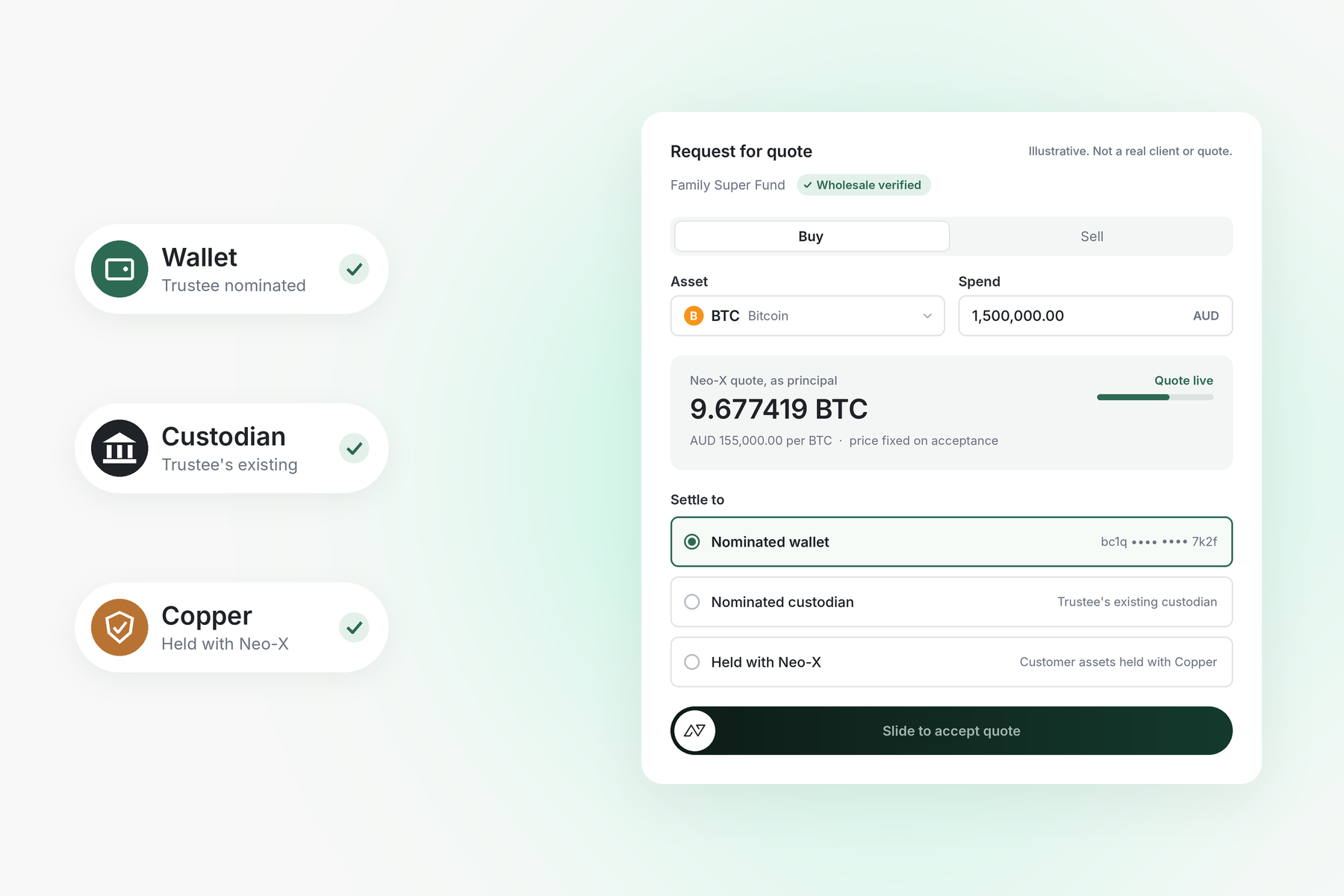
Custody Customer funds under custody are held with Copper, with $500 million insurance across BitGo and Copper. Clients may instead settle each trade direct to their own bank account, wallet or custodian and hold nothing with Neo-X. Neo-X acts as principal, makes markets, may hold positions in the assets it quotes, and is the client’s counterparty until the bought leg is delivered.
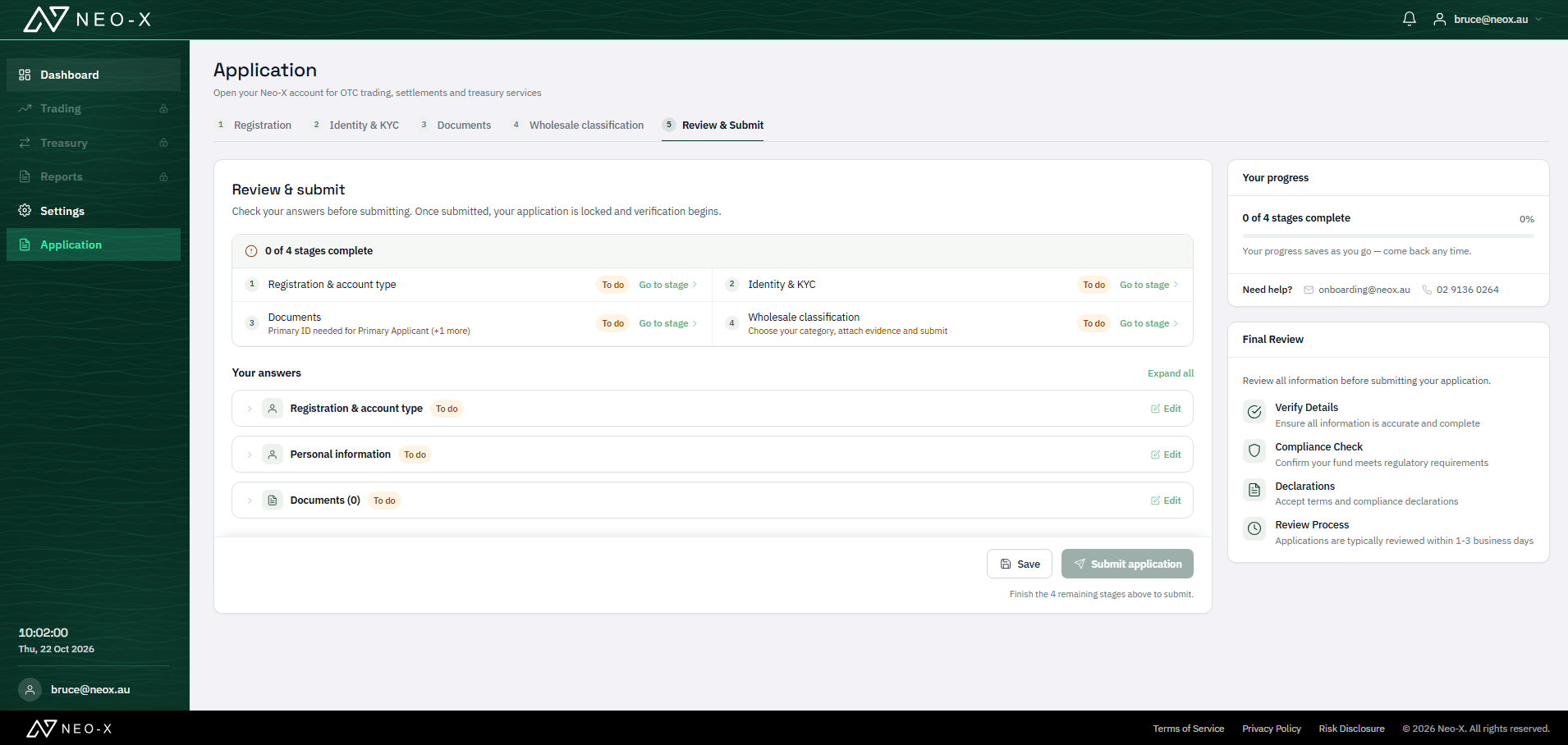
Access and Hours Desk chat with a named contact, web interface or API, with market, limit and RFQ or algorithmic order types, TWAP, VWAP and conditional order types. The desk is staffed 8am to 10pm AEST on business days, with 24-hour support for settlement and operational matters. Wholesale clients only; email sales@neox.au or call (02) 9136 0264 to begin onboarding.
Neo-X Financial Pty Ltd holds AFSL 558430. Client-facing services are provided by Neochain Pty Ltd, CAR 001320366. Wholesale clients only. Neo-X acts as principal, makes markets and may hold positions in the assets it quotes. Nothing on this page is financial product advice. Figures are approximate and not quotes.

Over-The-Counter: Buyer's Guide
What is an OTC desk?
An OTC desk, or liquidity provider, is the principal counterparty that buys and sells digital assets with clients directly, off-exchange, at a single quoted price. Compared with working the same order through an exchange order book, an OTC trade fills at one price rather than across several levels, is not limited by the depth visible on the book, and leaves no public print for other participants to trade against. OTC desks typically source liquidity from multiple venues: exchanges, market makers and banks.
What does this mean for Neo-X?
We source our liquidity from approximately 25 crypto exchanges, market makers and banks. We’ve taken the heavy lifting out of quote sourcing, so our clients trade with us at a single price point.
What does this mean for Australian wholesale clients?
In Australia, it’s difficult to get access to sharp pricing in wholesale sizes. Neo-X quotes one firm, all-in price in sizes from approximately A$100,000 to A$20 million, so a wholesale client sees institutional pricing without aggregating it themselves.
How does a trade with Neo-X work?
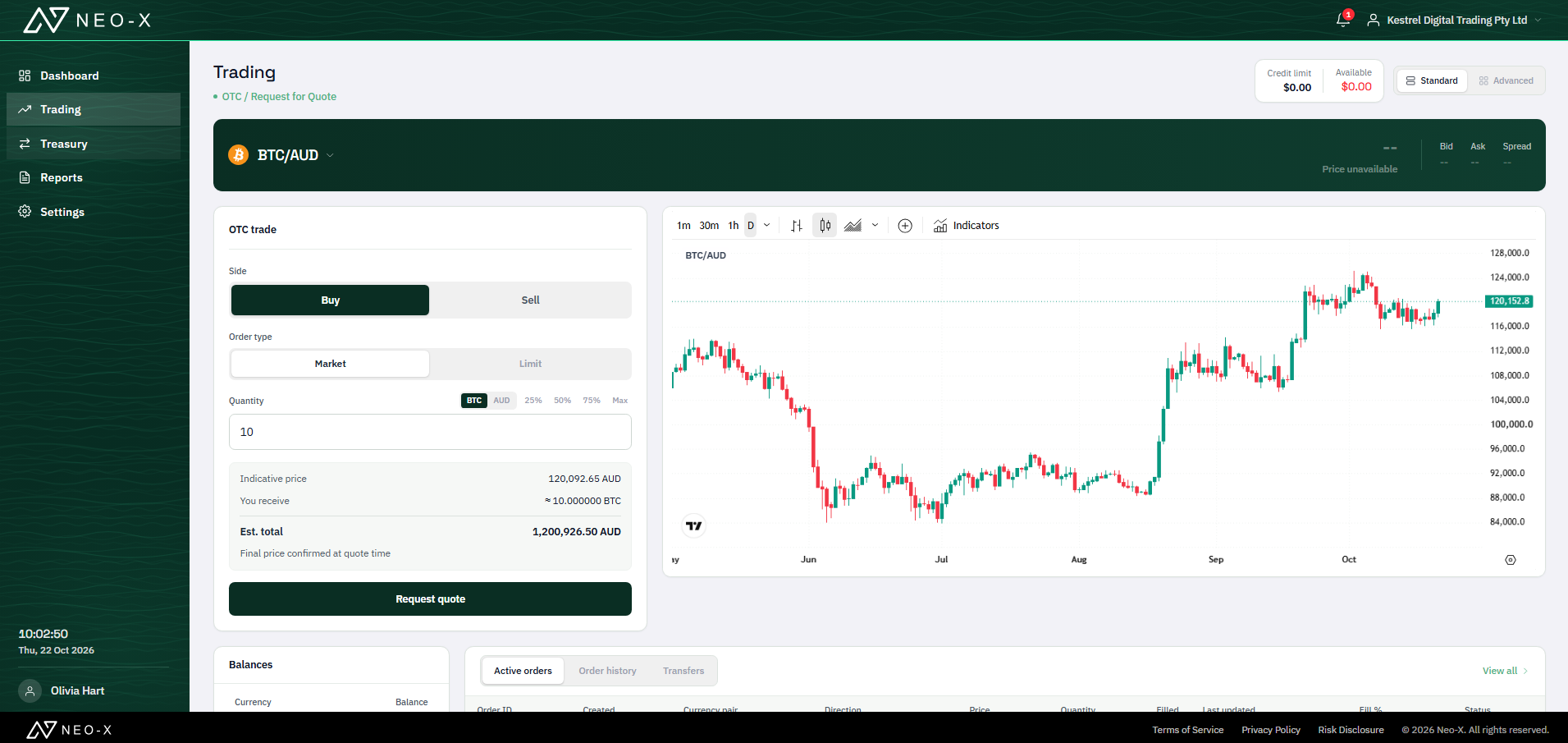
Request, quote, accept, settle. A client tells the desk the pair, side and size, by chat, web UI or API. Neo-X returns one firm price. The client accepts, and the order is filled. Settlement follows: the client delivers their leg, and Neo-X delivers the other side. Approximately 95% of our trades settle within one hour and 99% within two hours (as at October 2026). Every onboarded client has a $1 million trading facility by default, so no pre-funding is required.
Who can trade with Neo-X?
Wholesale clients only, as defined in sections 761G, 761GA and 708 of the Corporations Act. That covers exchanges, dealers and brokers, corporates, payments companies and MSBs, family offices, fund managers and wholesale high-net-worth individuals. Neo-X does not serve retail clients and does not quote privacy coins.
How do I get started?
Reach out on sales@neox.au or (02) 9136 0264 and we will take you through the onboarding process.
Neo-X Financial Pty Ltd holds AFSL 558430. Client-facing services are provided by Neochain Pty Ltd, CAR 001320366. Wholesale clients only. Neo-X acts as principal, makes markets and may hold positions in the assets it quotes. Nothing on this page is financial product advice. Figures are approximate and not quotes.
Neo-X Financial Granted Australian Financial Services Licence by ASIC
Neo-X Financial Pty Ltd (23 674 294 127), part of the Neo-X Group, has been granted an Australian Financial Services Licence by ASIC - for Wholesale Clients Only.
7 April 2026
Distributed ledger technology sits at the centre of one of the most consequential structural shifts in modern finance, evolving rapidly in real time.
We are pleased to announce to the market, that we have been granted an AFSL by ASIC. We're building the bridge between traditional financial systems and digital asset markets - delivering institutional-grade infrastructure that enables capital to move seamlessly across both environments within a strong regulatory framework.
"The AFSL reflects our unwavering commitment, not only to the standards required by the regulator, but also to those that we hold ourselves too internally. We welcome the new industry benchmark and look forward to broadening our service offering to a rapidly growing market."
Drew Kilroe - Chief Executive Officer
As the Australian market evolves, we remain focused on leading through change. We are well positioned to navigate the regulatory landscape and welcome a framework that enables constructive collaboration between industry and regulators.
OTC Trading
Neo-X will continue to expand its OTC offering. Providing liquidity solutions across more digital asset and fiat currency pairs. We will continue to refine our commercial offering, sharpening price, settlement speeds, and execution capabilities.
Trade Execution
Our execution model is channel agnostic. Clients access Neo-X through a combination of voice, chat, portal, or API best fits their workflow - execution quality, settlement standards, and service coverage are consistent across all of them.
Derivatives
Mitigate market exposures, secure cashflows, and create certainty through derivative strategies designed around the realities of our clients' businesses. Whether the exposure sits in cross-border payments, trading inventory, treasury operations, or digital asset positions, we structure forwards, swaps, and bespoke hedging products that match the underlying risk. The result is a hedging program that protects outcomes on terms that actually fit.
Non-Cash Payments
Our non-cash payment authorisation underpins how value moves through the Neo-X platform - across digital asset rails, fiat rails, and the cross-border flows that increasingly sit between them. We facilitate the settlement workflows that connect trade execution to client treasury, with controls embedded at every step. Every transaction running through our institutional-grade compliance infrastructure.
Client funds are held under our basic deposit authorisation while transactions are arranged and finalised, ensuring capital sits within a regulated framework throughout the entire trade lifecycle. For wholesale clients managing real flows - between counterparties, across borders, and across asset classes - non-cash payment capability is the difference between a desk that quotes prices and a counterparty that completes transactions. We've built the latter.
Neo-X Financial Pty Ltd (AFSL 558430) has been granted an Australian Financial Services Licence, available only to wholesale clients as per Sections 761GA and 708(10) of the Corporations Act 2001 (Cth) (Sophisticated / Wholesale Client). To serve these products, Neochain Pty Ltd (CAR No. 001320366) and NeoFX Pty Ltd (CAR No. 001320367) have been appointed as Corporate Authorised Representatives. We do not provide financial products or services to retail clients.

New Order Type: Conditional Orders
Perfect for investors and traders rotating between two currencies on a conditional price of another asset:
Sell currency XYZ if/when currency pair ABC hits your target price
Conditional Orders
Execute automatically when the market reaches your target.
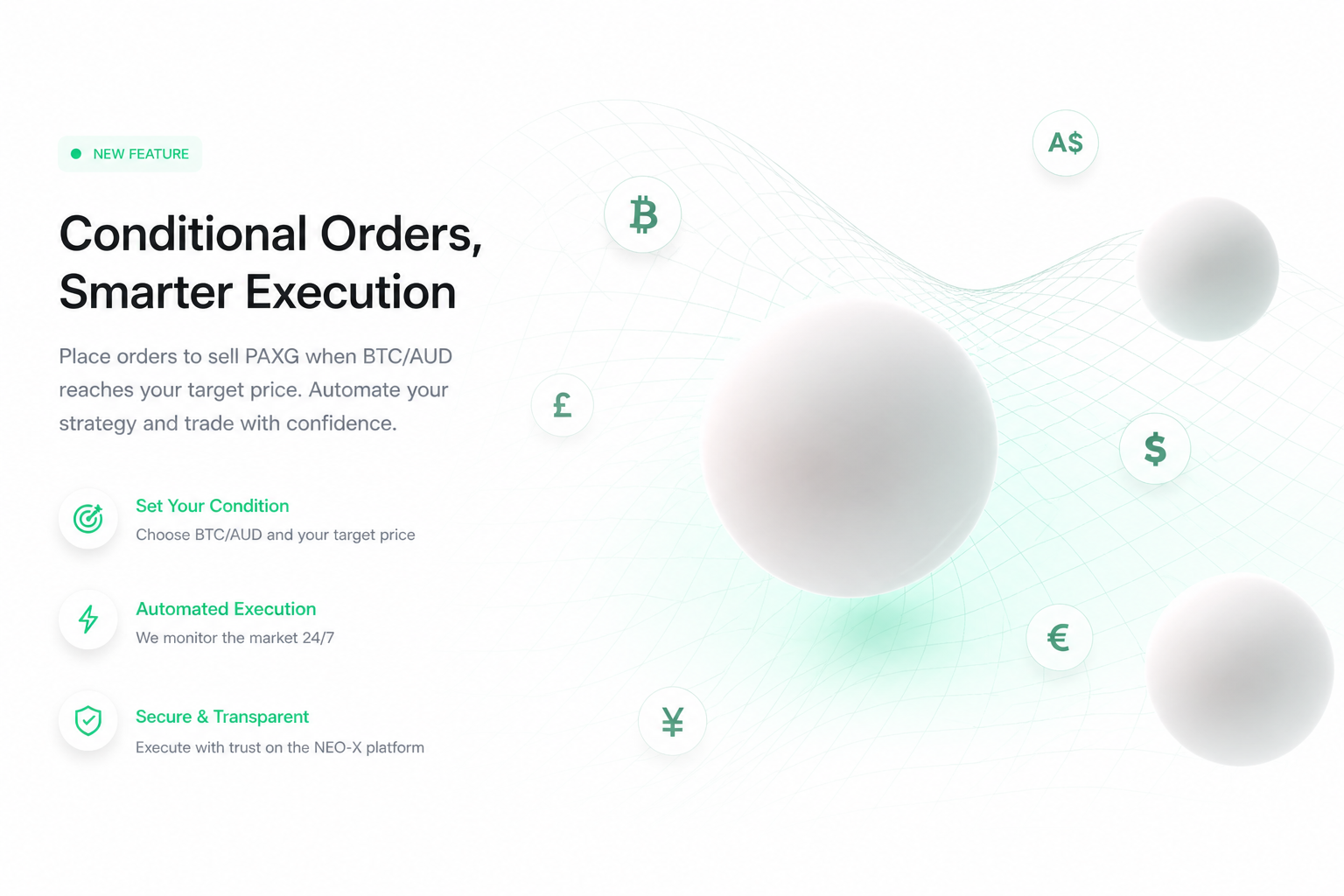
Conditional Orders allow you to predefine trading instructions that are activated when a specific market condition is met. For example, place an instruction to sell PAXG once BTC/AUD reaches a nominated price level - helping you execute strategy without constant market monitoring.
How it works
- Select the asset you want to buy or sell
- Define a trigger condition (e.g. BTC/AUD ≥ target price)
- Set your execution parameters
- Neo-X continuously monitors the market and automatically places the order once conditions are met
Designed for smarter execution, Conditional Orders help clients automate strategies, reduce manual intervention, and respond to market movements in real time.
Built for Smarter Execution
Conditional Orders extend Neo-X’s growing suite of execution tools, giving clients greater flexibility and control over how, when, and why trades are executed.
Alongside existing execution capabilities - including Market, Limit, TWAP and VWAP strategies - Conditional Orders allow clients to define trading actions based on external market conditions. Rather than reacting manually to price movements, clients can automate execution logic around predefined triggers and execution parameters.
Whether executing immediately, working larger orders over time, or automating strategy based on market events, Neo-X provides a flexible execution framework designed for institutional workflows and real-time decision making.


BitGo & Neo-X Custody Integration
Security-First Infrastructure
At the core of this partnership is BitGo’s qualified custody safeguarding assets with regulated cold storage, multi-sig security and $250M in insurance.
Seamless, scalable liquidity
BitGo and Neo-X provide deep liquidity and competitive execution offering institutions unparalleled efficiency for their trading strategies.
Global reach, local precision
BitGo’s global infrastructure and Neo-X strong presence in Australia means the best of both worlds for clients - global perspective with local understanding and enhanced support for Australian clients with international liquidity requirements. As digital asset markets mature, secure, regulated infrastructure is no longer optional.
Insurance
We've doubled our insurance coverage up to USD $500M, across two Custodian leaders; BitGo & Copper.
This partnership between BitGo and Neo-X empowers institutions to trade with confidence, backed by solutions built for performance, scale and reliability.


Clarity, at last?
Explainer: What does the Clarity Act actually do?
The Clarity Act is legislation that has not been required in approximately a decade. In Summary, it outlines what the regulator is in charge of and their powers accordingly. Furthermore, the bill divides digital assets into three categories and assigns each a regulatory home.
1. Digital commodities - defined as digital assets whose value is "intrinsically linked" to a functional blockchain - fall under the United States Commodity Futures Trading Commission. The CFTC would be granted exclusive jurisdiction over spot and cash markets for these assets, a substantial expansion of its authority. Exchanges, brokers, and dealers handling digital commodities would register with the CFTC as Digital Commodity Exchanges, Digital Commodity Brokers, and Digital Commodity Dealers.
2. Investment Contract Assets - remain with the Securities and Exchange Commission, preserving SEC authority over primary market crypto fundraising and tokens that retain securities characteristics.
3. Permitted payment stablecoins - already addressed in the GENIUS Act passed last year - sit with banking regulators, with the SEC and CFTC retaining anti-fraud jurisdiction over stablecoin transactions on registered venues.

A few specific provisions deserve attention
Stablecoin yield is restricted, not banned. The bill prohibits digital asset service providers from paying customers passive, deposit-like interest on payment stablecoin balances, but permits bona fide activity-based or transaction-based rewards under joint SEC, CFTC, and Treasury rules. This was the single most contested element of the negotiation and reflects a compromise between the crypto industry and the US banking sector.
What this means for the U.S. Market
Clear rules - unlock institutional participants that have been waiting on the sidelines for a decade. The clearest near-term effects:
Banking integration. Qualifying banks can hold and transact in digital commodities for the first time without bespoke OCC guidance or state-by-state interpretation. In a structural and durable environment.
Custody normalisation. The bill creates a qualified digital asset custodian standard, which gives institutional allocators a defensible framework for satisfying their own custody and fiduciary requirements.
Stablecoin product differentiation. With passive yield prohibited, the US market will likely bifurcate further between transactional stablecoins (USDC, USDT-style) and yield-bearing instruments structured as securities or tokenised money market funds.
Onshoring of liquidity. Industry advocates have framed this consistently as bringing market activity back into US jurisdiction. Whether the bill becomes law, and on what timeline, will materially shape where global liquidity sits in 2027.

Neo-X Statement
Australia is moving rapidly toward a more mature and fit-for-purpose digital asset regulatory framework. The Corporations Amendment (Digital Assets Framework (DAF)) Bill 2025 received Royal Assent on 8 April 2026, commencing on 9 April 2027 with a six-month transition period. The framework extends the existing AFSL regime to cover Digital Asset Platforms (DAPs) and Tokenised Custody Platforms (TCPs), while expanded AML/CTF obligations under AUSTRAC’s Virtual Asset Service Provider regime begin from 1 July 2026.
Despite a different regulatory architecture, Australia is converging with global markets by bringing custody into financial-services licensing, applying AML/CTF obligations as a baseline, and creating coordinated frameworks for tokenised assets and digital commodities.
Neo-X is well positioned for this transition. Operating under an Australian Financial Services Licence within the group, alongside Digital Currency Exchange and Independent Remittance registrations with AUSTRAC, Neo-X has proactively developed a dynamic, July-2026 travel rule-ready system. As regulation evolves, we remain focused on compliance, institutional-grade infrastructure, and delivering innovative FX and digital asset solutions for Australian wholesale businesses.
To learn more about Neo-X’s services, institutional liquidity, FX and digital asset markets, visit Neo-X

OTC Derivatives at Neo-X
Neo-X's OTC derivatives desk has been live since March 2026, operating under AFSL 558430 for wholesale clients only.
What the desk does
The desk prices and trades FX and cryptocurrency derivatives directly, off-exchange and as principal. Each contract is sized and dated to the client's specific requirements: notional, tenor, strike, settlement currency and settlement method are agreed per trade rather than taken from a listed contract. Underlyings are bitcoin, other digital assets in the OTC coverage list, AUD crosses and other foreign exchange pairs.
Structures
Linear. Forwards, swaps and cross-currency swaps. A fixed price in both directions, with mark-to-market valuations over the life of the trade.
Vanilla options. European, American and Asian puts and calls. Premium paid is lost if the option expires out of the money; selling options creates an open-ended obligation.
Structured hedging. Collars, spreads, seagulls and participators. Lower or zero premium in exchange for capped upside or partial protection.
Yield. Covered calls, iron condors, digitals, sharkfins, knock-outs and target redemption forwards. Losses in an adverse scenario can exceed the premium, and are uncapped on some structures.
Bespoke. Combinations of the above, including BTC-collateralised FX structures.
FX: fixing the cost of a US dollar payable
A Sydney importing company has US$5 million to pay in three months. With AUD/USD at 0.6600 and the three-month forward at 0.6620, the forward fixes the AUD cost at A$7.55 million whatever the rate does. The zero-cost collar leaves the cost floating between a floor at 0.6400 and a cap at 0.6900: protected if the Australian dollar falls below the floor, but giving up the benefit if it rises above the cap. Lower on the chart is cheaper.
Bitcoin: four ways to shape a holding
A holder of 400 BTC with spot at US$60,000 and the forward at US$66,000. The collar sets a floor and a cap at zero premium. The forward plus a bought call fixes the price and buys the upside back above US$72,000, for a premium. The participator fixes half the position and leaves the rest open. The covered call receives a premium today and gives up gains above US$70,000, with no protection below. Higher on the chart is a higher value for the holding.
Illustrative payoffs at expiry, before margin and funding. Strikes, rates and sizes are chosen for clarity and are not quotes. Green: better than unhedged. Red: worse than unhedged.
Why clients trade these structures
To fix or bound a cash flow they already know is coming. A miner selling next quarter's production, a payments company with a US dollar payable due in ninety days, a fund with a redemption to meet in AUD. The exposure exists whether or not it is hedged; a forward or collar replaces an unknown rate with a known one, or with a known range, so the budget holds whatever spot does in between.
To change the shape of a holding without selling it. A treasury or family office that wants to keep its bitcoin, or its foreign-currency balance, but not its full exposure to the price. A collar sets a floor and a cap on the position; a covered call receives a premium today in exchange for giving up gains above the strike. The asset stays where it is, and the return profile changes.
In both cases the client is choosing which outcomes to give up in order to remove others. The desk prices the trade-off; it does not advise on whether to take it.
Execution and margin
Pricing is on request by chat, UI or API. The desk returns a firm, dealable quote with strikes, premium or forward rate, and settlement terms; on acceptance a confirmation issues under the client agreement. Margin is posted in any fiat currency or crypto asset, with variation margin on mark-to-market moves. Crypto posted as margin is itself marked to market. Positions can be unwound or restructured at market before expiry, which realises the gain or loss at that point.
Settlement
Settlement runs on the same rails as the OTC spot desk: same-day in 27 fiat currencies through the Neo-X Global Settlement Network, or on-chain to the client's nominated address.
Who it is for
Wholesale clients only, under sections 761G and 761GA of the Corporations Act 2001 (Cth): corporate and Web3 treasuries, payments companies and MSBs, family offices, fund managers, exchanges, dealers and brokers. Neo-X does not give personal advice or assess suitability. The desk shows the payoff under adverse and favourable scenarios before dealing, and the client decides.
Access
Existing OTC clients can request derivatives pricing from the desk directly - subject to suitability approval. New clients email sales@neox.au or call (02) 9136 0264. Desk hours 8am to 10pm AEST, with 24-hour support.
Neo-X Financial Pty Ltd holds AFSL 558430. Client-facing services are provided by Neochain Pty Ltd, CAR 001320366. Wholesale clients only. Neo-X acts as principal, makes markets, hedges across listed and OTC venues and its own inventory, and may hold positions in the assets it quotes. Derivatives carry risk, including loss exceeding any premium received and margin calls. Nothing on this page is financial product advice.
On/Off-ramping In Australia
Crypto on-ramping is the process of converting fiat, meaning government-issued currency such as AUD or USD, into cryptocurrency. Conversely, off-ramping is selling cryptocurrency for fiat. Investment and speculation aside, businesses use blockchain rails for near-real-time settlement that runs 24 hours a day, lower transfer costs on many corridors, and programmable cross-border payments. Increasingly, Australian businesses are building cryptocurrency transfers into their payment and treasury workflows: importers on-ramp capital to fund overseas suppliers, payment companies use stablecoins for near-real-time global remittance, and fund managers trade and settle outside banking hours. One metric we watch: stablecoins moving across borders rose 77.5%, from US$124.2 billion to US$220.3 billion, in the year to June 2026, with monthly value more than doubling from US$11 billion in January 2025 to US$24 billion in June 2026. Chainalysis describes this as a conservative on-chain estimate.
Source: Chainalysis, 2026 Global Crypto Adoption Index.
USDT/AUD: the Pair Most Australian Businesses Ramp Through
USDT against the Australian dollar is the most traded pair for on/off-ramping. USDT is the largest stablecoin measured by supply, roughly US$187 billion in circulation as at June 2026, about 59% of the total stablecoin market (DefiLlama), a first preference for offshore suppliers, exchanges and payment counterparties.
Two things make USDT/AUD different from a plain FX trade. First, the price has two parts: the AUD/USD rate and the USDT/USD basis, because USDT trades at its own value against the dollar, usually within a few basis points of one. A USDT/AUD quote reflects both at the moment it is given. Second, the two legs move on different rails: the AUD leg settles through the Australian banking system, and the USDT leg settles on-chain on the network the client nominates, so the speed of the slower leg sets the speed of the trade.
Liquidity in USDT/AUD can be uneven. Exchange order books for the pair are thin relative to USDT/USD, so an order of a few hundred thousand dollars can walk the book. Neo-X prices USDT/AUD in one firm, all-in rate for tickets from A$100,000 to A$20 million, in either direction, which is the reason the pair sits at the centre of how Neo-X on-and-off-ramps for wholesale clients.
On/off-ramping: Exchange Vs. OTC Desk
An exchange order book and an over-the-counter (OTC) desk solve different problems. The order book suits small, frequent conversions where the business wants to see the market and work an order. The OTC desk suits larger trades, where the business wants one price, no slippage and delivery straight to its bank account or wallet; speed and price are the primary drivers.
What to Consider When Choosing an OTC Provider in Australia
Licensing and entity Which legal entity you are contracting with, what licence it holds and what that licence authorises. In Australia, an Australian Financial Services Licence and an AUSTRAC registration as a virtual asset service provider are different things: the first is a financial services authorisation with conduct, competence and compensation obligations; the second is an anti-money-laundering registration. Both can be checked on the ASIC and AUSTRAC public registers, and the entity named on the register should match the entity you are facing. Licensing and AUSTRAC registration should be treated as the minimum requirement when deciding who to trade with.
Pricing method Is the quote all-in, meaning the price you accept is the price you pay, with no commission, settlement or custody fee added afterwards.
Size & Settlement What is the minimum and maximum single trade size in the specific fiat or cryptocurrency you are buying or selling. Different OTC desks have access to different liquidity, and a desk may be deep in one set of currencies and thin in others; checking this before onboarding saves time. Ask what settlement rails the desk uses, whether it has access to NPP (AUD), FedNow (USD) and SEPA Instant (EUR), and which cryptocurrency networks are available for settlement. Banking and settlement infrastructure determines how fast the other side of your trade arrives.
Pre-funding Does the provider require funds on account before the price is secured, or does it offer a trading or settlement facility so the rate is locked first.
Custody Who the provider uses for custody, whether the custodian is licensed or regulated, and in which jurisdiction.
Access and Hours How you request a price, whether by chat, web interface or API; when the desk is staffed; and what support exists outside those hours for settlement or operational issues.
How to On/Off-ramp with Neo-X
Licensing and Entity Neo-X Financial Pty Ltd holds Australian Financial Services Licence 558430, which authorises it to provide and make a market in non-cash payment facilities, basic deposit products, derivatives and FX contracts for wholesale clients. Client-facing services are provided by Neochain Pty Ltd, Corporate Authorised Representative 001320366. Neo-X has been an AUSTRAC reporting entity since 2022 and is a registered virtual asset service provider. Both entities can be checked on the ASIC and AUSTRAC public registers, and they are the entities named on the client agreement.
Pricing Method All-in. Neo-X returns one request-for-quote price built from approximately 25 venues (exchanges, banks and market makers), firm for the quote window, and the price the client accepts is the price the client pays. There is no commission, settlement fee or custody fee added on spot tickets; Neo-X makes money via the the spread.
Size and Settlement Approximately A$100,000 to A$20 million per ticket, in either direction, across approximately 60 digital assets and 27 fiat currencies. AUD/USDT is the most traded pair and the deepest; USDC and AUD-denominated stablecoins are quoted on the same terms. Fiat settles same day across 27 currencies through the Neo-X Global Settlement Network, with access to NPP for AUD, FedNow for USD and SEPA Instant for EUR. Stablecoins settle on-chain to the client’s nominated address. Approximately 95% of Neo-X trades settle within one hour and 99% within two hours (as at October 2026).
Pre-funding Not required. Every onboarded client has an A$1 million trading facility by default, so the rate is secured first and the client’s leg follows within the agreed settlement window. Larger facilities are agreed after credit review.
Custody Customer funds under custody are held with Copper, with $500 million insurance across BitGo and Copper. Clients may instead settle each trade direct to their own bank account, wallet or custodian and hold nothing with Neo-X. Neo-X acts as principal, makes markets, may hold positions in the assets it quotes, and is the client’s counterparty until the bought leg is delivered.
Access and Hours Desk chat with a named contact, web interface or API, with market, limit and RFQ or algorithmic order types, TWAP, VWAP and conditional order types. The desk is staffed 8am to 10pm AEST on business days, with 24-hour support for settlement and operational matters. Wholesale clients only; email sales@neox.au or call (02) 9136 0264 to begin onboarding.
Neo-X Financial Pty Ltd holds AFSL 558430. Client-facing services are provided by Neochain Pty Ltd, CAR 001320366. Wholesale clients only. Neo-X acts as principal, makes markets and may hold positions in the assets it quotes. Nothing on this page is financial product advice. Figures are approximate and not quotes.
Over-The-Counter: Buyer's Guide
What is an OTC desk?
An OTC desk, or liquidity provider, is the principal counterparty that buys and sells digital assets with clients directly, off-exchange, at a single quoted price. Compared with working the same order through an exchange order book, an OTC trade fills at one price rather than across several levels, is not limited by the depth visible on the book, and leaves no public print for other participants to trade against. OTC desks typically source liquidity from multiple venues: exchanges, market makers and banks.
What does this mean for Neo-X?
We source our liquidity from approximately 25 crypto exchanges, market makers and banks. We’ve taken the heavy lifting out of quote sourcing, so our clients trade with us at a single price point.
What does this mean for Australian wholesale clients?
In Australia, it’s difficult to get access to sharp pricing in wholesale sizes. Neo-X quotes one firm, all-in price in sizes from approximately A$100,000 to A$20 million, so a wholesale client sees institutional pricing without aggregating it themselves.
How does a trade with Neo-X work?
Request, quote, accept, settle. A client tells the desk the pair, side and size, by chat, web UI or API. Neo-X returns one firm price. The client accepts, and the order is filled. Settlement follows: the client delivers their leg, and Neo-X delivers the other side. Approximately 95% of our trades settle within one hour and 99% within two hours (as at October 2026). Every onboarded client has a $1 million trading facility by default, so no pre-funding is required.
Who can trade with Neo-X?
Wholesale clients only, as defined in sections 761G, 761GA and 708 of the Corporations Act. That covers exchanges, dealers and brokers, corporates, payments companies and MSBs, family offices, fund managers and wholesale high-net-worth individuals. Neo-X does not serve retail clients and does not quote privacy coins.
How do I get started?
Reach out on sales@neox.au or (02) 9136 0264 and we will take you through the onboarding process.
Neo-X Financial Pty Ltd holds AFSL 558430. Client-facing services are provided by Neochain Pty Ltd, CAR 001320366. Wholesale clients only. Neo-X acts as principal, makes markets and may hold positions in the assets it quotes. Nothing on this page is financial product advice. Figures are approximate and not quotes.
Neo-X Financial Granted Australian Financial Services Licence by ASIC
Neo-X Financial Pty Ltd (23 674 294 127), part of the Neo-X Group, has been granted an Australian Financial Services Licence by ASIC - for Wholesale Clients Only.
7 April 2026
Distributed ledger technology sits at the centre of one of the most consequential structural shifts in modern finance, evolving rapidly in real time.
We are pleased to announce to the market, that we have been granted an AFSL by ASIC. We're building the bridge between traditional financial systems and digital asset markets - delivering institutional-grade infrastructure that enables capital to move seamlessly across both environments within a strong regulatory framework.
"The AFSL reflects our unwavering commitment, not only to the standards required by the regulator, but also to those that we hold ourselves too internally. We welcome the new industry benchmark and look forward to broadening our service offering to a rapidly growing market."
Drew Kilroe - Chief Executive Officer
As the Australian market evolves, we remain focused on leading through change. We are well positioned to navigate the regulatory landscape and welcome a framework that enables constructive collaboration between industry and regulators.
OTC Trading
Neo-X will continue to expand its OTC offering. Providing liquidity solutions across more digital asset and fiat currency pairs. We will continue to refine our commercial offering, sharpening price, settlement speeds, and execution capabilities.
Trade Execution
Our execution model is channel agnostic. Clients access Neo-X through a combination of voice, chat, portal, or API best fits their workflow - execution quality, settlement standards, and service coverage are consistent across all of them.
Derivatives
Mitigate market exposures, secure cashflows, and create certainty through derivative strategies designed around the realities of our clients' businesses. Whether the exposure sits in cross-border payments, trading inventory, treasury operations, or digital asset positions, we structure forwards, swaps, and bespoke hedging products that match the underlying risk. The result is a hedging program that protects outcomes on terms that actually fit.
Non-Cash Payments
Our non-cash payment authorisation underpins how value moves through the Neo-X platform - across digital asset rails, fiat rails, and the cross-border flows that increasingly sit between them. We facilitate the settlement workflows that connect trade execution to client treasury, with controls embedded at every step. Every transaction running through our institutional-grade compliance infrastructure.
Client funds are held under our basic deposit authorisation while transactions are arranged and finalised, ensuring capital sits within a regulated framework throughout the entire trade lifecycle. For wholesale clients managing real flows - between counterparties, across borders, and across asset classes - non-cash payment capability is the difference between a desk that quotes prices and a counterparty that completes transactions. We've built the latter.
Neo-X Financial Pty Ltd (AFSL 558430) has been granted an Australian Financial Services Licence, available only to wholesale clients as per Sections 761GA and 708(10) of the Corporations Act 2001 (Cth) (Sophisticated / Wholesale Client). To serve these products, Neochain Pty Ltd (CAR No. 001320366) and NeoFX Pty Ltd (CAR No. 001320367) have been appointed as Corporate Authorised Representatives. We do not provide financial products or services to retail clients.
New Order Type: Conditional Orders
Perfect for investors and traders rotating between two currencies on a conditional price of another asset:
Sell currency XYZ if/when currency pair ABC hits your target price
Conditional Orders
Execute automatically when the market reaches your target.
Conditional Orders allow you to predefine trading instructions that are activated when a specific market condition is met. For example, place an instruction to sell PAXG once BTC/AUD reaches a nominated price level - helping you execute strategy without constant market monitoring.
How it works
- Select the asset you want to buy or sell
- Define a trigger condition (e.g. BTC/AUD ≥ target price)
- Set your execution parameters
- Neo-X continuously monitors the market and automatically places the order once conditions are met
Designed for smarter execution, Conditional Orders help clients automate strategies, reduce manual intervention, and respond to market movements in real time.
Built for Smarter Execution
Conditional Orders extend Neo-X’s growing suite of execution tools, giving clients greater flexibility and control over how, when, and why trades are executed.
Alongside existing execution capabilities - including Market, Limit, TWAP and VWAP strategies - Conditional Orders allow clients to define trading actions based on external market conditions. Rather than reacting manually to price movements, clients can automate execution logic around predefined triggers and execution parameters.
Whether executing immediately, working larger orders over time, or automating strategy based on market events, Neo-X provides a flexible execution framework designed for institutional workflows and real-time decision making.
BitGo & Neo-X Custody Integration
Security-First Infrastructure
At the core of this partnership is BitGo’s qualified custody safeguarding assets with regulated cold storage, multi-sig security and $250M in insurance.
Seamless, scalable liquidity
BitGo and Neo-X provide deep liquidity and competitive execution offering institutions unparalleled efficiency for their trading strategies.
Global reach, local precision
BitGo’s global infrastructure and Neo-X strong presence in Australia means the best of both worlds for clients - global perspective with local understanding and enhanced support for Australian clients with international liquidity requirements. As digital asset markets mature, secure, regulated infrastructure is no longer optional.
Insurance
We've doubled our insurance coverage up to USD $500M, across two Custodian leaders; BitGo & Copper.
This partnership between BitGo and Neo-X empowers institutions to trade with confidence, backed by solutions built for performance, scale and reliability.
Market Update: 29 October 2026
Thursday 29 October 2026, 10:00 AEDT. Commentary from the Neo-X OTC desk and the Neo-X derivatives desk. Wholesale clients only. Prices are from public sources and are illustrative, not quotes.
Gold, oil and the US curve set the tone: WTI settled at US$102.78 (+2.9%) and the 10-year is back above 5% while the 2-year eased after the hold, so the curve steepened. In FX the dollar firmed against the euro and sterling into the Fed while AUD/USD finished the week where it started. In digital assets bitcoin held its US$80,000 to 82,000 range (−3.3% on the week) and ether underperformed; among the desk's active names HYPE was flat, XLM and SUI were weaker, and tokenised gold tracked spot lower.
Markets
Bitcoin held its range through the Fed. Spot printed an intraday high of US$81,687 early Wednesday US time, slipped below US$80,400 into the decision and traded near US$81,000 after it; at 10:00 AEDT it is US$81,265. The 90-day high of US$86,594 (20 September) has been rejected twice and October has been a grind lower from US$86,500, but the US$80,000 to 82,000 band has now absorbed a weekend dip, the CPI and the FOMC. Coinglass data put Wednesday's bitcoin liquidations near US$58 million, of which more than US$46 million were shorts, and total crypto liquidations above US$167 million with about US$110 million from shorts, so the positioning squeezed by the Fed was short, not long. Galaxy's Alex Thorn has argued the bear market ended in June below US$58,000 and cites a daily close above US$82,500 as the level that would confirm the recovery. ETF flows remain the missing piece: spot bitcoin ETFs took in US$110 million on Monday, but October as a whole has seen more than US$1 billion leave bitcoin and ether ETFs.
Ether has underperformed; a few alts have not. ETH/USD is down 12.1% over 30 days against 2.6% for bitcoin, and the ETH/BTC ratio has fallen from about 0.032 at the start of October to 0.029. Against that, Zcash rose about 8% to US$1,320 and HYPE about 5% to US$81 on Wednesday, with XRP and DOGE up around 3% and SOL 2%; the alt complex is selective rather than broad.
Stablecoin supply is contracting at the margin. Total stablecoin capitalisation was US$300.4 billion at 25 October (DefiLlama), down US$12.7 billion from the May peak. USDT is US$182.4 billion (60.7% share), down US$1.3 billion over 30 days; USDC is US$71.7 billion, down US$4.7 billion over 30 days. Less stablecoin on the sidelines means less immediate buying capacity, and it is consistent with the ETF outflows.
Equities, oil and the curve. US equities closed modestly higher after the Fed, with the S&P 500 at 7,744 and the Nasdaq Composite at 26,550; the ASX 200 gave up a near-1% gain after the CPI to close flat at about 8,847, with energy the drag. December WTI settled at US$102.78 (+2.9%) and Brent at US$115.32, and crude is the thread that runs through both the Australian fuel component and the Fed's inflation language. The US 10-year closed back above 5% at 5.02% while the 2-year eased to 4.71%, so the curve steepened on the hold. Gold slipped 0.5% to about US$4,038. Big-tech earnings land Wednesday and Thursday US time.
The Australian dollar. AUD/USD reached about 0.7045 mid-morning Wednesday on the CPI, settled near 0.703 by the Sydney close and is 0.7033 this morning after a Fed hold that was fully priced. The pair fell from 0.7225 in mid-September to 0.6940 by early October as the US dollar firmed on Fed hike pricing, and has recovered as RBA hike pricing caught up; with both central banks now leaning the same way, the rate differential is doing less work and the pair has gone quiet. On the crosses AUD/NZD is up 1.4% on the week to 1.2529, with the New Zealand dollar the weakest G10 currency on Wednesday, while EUR/USD and GBP/USD are both down about 0.9% on the week as the dollar firmed into the Fed.
Politics and policy
Australia: a November hike is now the base case. The ABS September CPI, released Wednesday, showed headline inflation at 4.3% year on year (up from 4.0% in August) and 1.3% for the September quarter. The trimmed mean rose 1.0% in the quarter and 3.6% over the year, in line with bank forecasts but above the RBA's own August forecast of 0.8% for the quarter. Housing (+5.2%, with electricity +12.8% as Commonwealth rebates expired) and transport (+8.7%, with automotive fuel +23.6% on oil) were the largest contributors. Market pricing for a hike on 3 November moved from about 60% before the release to 79%, and was quoted near 90% in the immediate aftermath. CBA switched its call from hold to a 25 basis point "insurance hike"; ANZ said the data "cements" a November move; Westpac already had a hike and does not expect more beyond it. Deputy Governor Hauser said the numbers were broadly as expected but "too high". The cash rate is 4.60% after four hikes this year, the last on 29 September. Unemployment at 4.7%, a five-year high, remains the argument for stopping after one.
United States: a hawkish hold. The FOMC held the funds rate at 3.75 to 4.00% at 5:00am AEDT this morning, as about 90% of the market expected. The vote was split: Governor Lisa Cook and Cleveland Fed President Beth Hammack dissented in favour of a 25 basis point hike. The statement kept "inflation remains elevated" and said the committee "will deliver price stability". Chair Warsh said capital expenditure strength is "not just strong, but it is broadening", said politics and the midterms were not discussed, and announced that from 2027 one of the eight annual meetings will be a strategy session with no rate vote, rising to two in 2028. Fed funds futures after the decision point to a strong possibility of a hike at the 8 to 9 December meeting, with one or two more priced for 2027. For AUD/USD and bitcoin the message is that the December hike debate is live, but the market had already priced most of it.
US midterms, 3 November. Polls and prediction markets have favoured Democrats to take the House, with the Senate close. For digital asset policy the relevant point is that the CLARITY Act (market structure) failed a Senate cloture vote 49 to 50 on 15 September and is widely considered dead for this Congress, so the rule-making has moved to the agencies: the SEC's proposed Regulation Crypto Assets closed for comment on 20 October, and the CFTC's crypto market rule is at OIRA review ahead of a formal proposal. Fairshake has committed US$30 million against Sherrod Brown's Ohio Senate bid. A bipartisan crypto tax bill passed House Ways and Means in September and now has a Senate version.
Australia's own regime is further along. The Corporations Amendment (Digital Assets Framework) Act commences 9 April 2027 and brings digital asset platforms and tokenised custody platforms under the AFSL regime, and the expanded AUSTRAC virtual asset service provider obligations, including the travel rule, have applied since 1 July 2026. Neo-X Financial already operates under AFSL 558430 and has been an AUSTRAC reporting entity since 2022.
What we are watching
- Thu and Fri, US time: big-tech earnings. Crypto has traded with semiconductors and AI capex in October; a weak print would test US$80,000 again, a strong one puts Galaxy's US$82,500 daily-close level in reach.
- Fri 30 Oct, US: any first reading of how the dissents reprice December in fed funds futures; a move above 70% for a December hike would firm the US dollar.
- Sat 31 Oct: Celestia unlock of 5.58 million TIA.
- Tue 3 Nov, 2:30pm AEDT: RBA decision and Statement on Monetary Policy with new forecasts. A 25 basis point hike to 4.85% is about 80% priced; the forecasts and whether the board signals one-and-done will matter more than the move.
- Tue 3 Nov (US), results Wed 4 Nov AEDT: US midterms. Control of the Senate determines whether a revived market-structure bill is possible in 2027.
- Daily: US spot bitcoin ETF flows (Farside). Three consecutive inflow days would be the first since early October.
- Fri 25 Dec expiry: the US$72,000 bitcoin put remains the most traded option; open interest at that strike is the market's stated downside reference
OTC desk view
USDT/USD. Taking Binance USDC/USDT as the reference and inverting it, USDT has traded below par every day since 6 October, between 7 and 14 basis points under the dollar for the past fortnight; it closed at 0.9991 on Wednesday (8 basis points under) after a 30-day low of 14 basis points under on Monday. That discount is small in absolute terms but it is persistent, and it is the part of an AUD/USDT price that is not AUD/USD. On Wednesday the Kraken USDT/AUD close of 1.4154 sat about 45 basis points below the ECB USD/AUD rate of 1.4219, so the AUD leg was doing most of the work; that gap reflects thin AUD-pair liquidity around the CPI and Fed rather than anything about tether. For a client converting AUD into USDT the basis is a small tailwind; for a client selling USDT back into AUD it is a small cost. Our quotes combine the two legs into one all-in AUD/USDT rate, so the basis shows up in the rate rather than as a separate fee.
Flow. Client flow over the past week has been steady bitcoin accumulation, with off-ramping back into AUD running at a broadly balanced pace against it, so the desk has been two-way in AUD/BTC rather than one-directional. Altcoin activity has been quieter than usual conditions; the exceptions have been HYPE, XLM, SUI and XAUT (tokenised gold), where client interest has stood out against an otherwise subdued book. These are observations of what the desk has seen, not a view on where prices go next.
Liquidity and settlement. The Fed window has passed; the next event is the RBA at 2:30pm AEDT Tuesday, which falls inside Sydney hours when AUD depth is at its best, so there is no need to pre-position for liquidity reasons. Depth in AUD pairs remains thinnest between the US close and the Sydney open. Clients with size to move around the RBA can secure a rate and settle within the trading facility either side of the announcement. Same-day AUD settlement via NPP and on-chain USDT settlement are unchanged.
Derivatives desk view
Bitcoin options. The 25-delta put-call skew is positive across tenors, meaning puts cost more than equidistant calls, and the US$72,000 put expiring 25 December has been the most traded contract for several sessions. Wednesday's liquidations were two-thirds shorts, which says the leveraged futures book had leaned short into the Fed and was squeezed on a non-event. With the decision out of the way, front-end implied volatility should bleed unless earnings surprise; that is the configuration in which collars are cheapest for a holder, because the put the client buys is still bid on skew while the call the client sells is bid on the US$82,500 breakout debate.
Illustrative structure, not a quote: a two-month BTC collar. A holder of bitcoin at spot US$81,250 buys a US$72,000 put and sells a US$90,000 call to 25 December, structured for zero net premium (zero-cost means zero premium paid up front, not zero risk). At expiry: below US$72,000 the holder is protected at US$72,000 and gives up nothing further; between US$72,000 and US$90,000 the holder keeps the full move in either direction; above US$90,000 the holder's gains are capped at US$90,000 and the upside beyond that is forgone. If bitcoin is at US$95,000 at expiry the holder receives US$90,000 for the capped portion; if it is at US$65,000 the holder receives US$72,000. Strikes, dates and the zero-premium pairing are chosen for illustration; live strikes depend on the volatility surface at the time of the quote, and margin is called on mark-to-market moves over the life of the trade.
AUD/USD. With the Fed done and the RBA on 3 November, one-week AUD/USD implied volatility is the expensive part of the curve and the Fed premium has come out of it. Clients with a known USD payable or receivable in the next fortnight have been asking about forwards and collars that straddle both meetings. The same symmetry applies: a collar removes the outcomes beyond the strikes in both directions.
What would change the view. An RBA that hikes on 3 November and signals more would lift AUD/USD towards the 0.7225 September high and widen the rate differential against a Fed that paused. A hold would do the opposite and would surprise an 80% priced market. For bitcoin, a daily close above US$82,500 on resumed ETF inflows would flatten the put skew; a break of US$80,000 on volume with outflows resuming puts the US$72,000 strike in play and makes protection materially more expensive to buy after the fact.
Neo-X Financial Pty Ltd holds AFSL 558430. Client-facing services are provided by Neochain Pty Ltd, CAR 001320366. Wholesale clients only, as defined in sections 761G, 761GA and 708 of the Corporations Act 2001 (Cth). Neo-X acts as principal, makes markets, hedges across listed and OTC venues and its own inventory, and may hold positions in the assets it quotes. Derivatives carry risk, including loss exceeding any premium received and margin calls. Market data from Kraken, Binance, the ECB via Frankfurter, Trading Economics, Farside, DefiLlama, Glassnode, CoinDesk, Coinglass, the ABS and the RBA; figures are approximate and are not quotes. Nothing in this update is financial product advice or a recommendation to trade. Contact sales@neox.au or (02) 9136 0264.
Clarity, at last?
Explainer: What does the Clarity Act actually do?
The Clarity Act is legislation that has not been required in approximately a decade. In Summary, it outlines what the regulator is in charge of and their powers accordingly. Furthermore, the bill divides digital assets into three categories and assigns each a regulatory home.
1. Digital commodities - defined as digital assets whose value is "intrinsically linked" to a functional blockchain - fall under the United States Commodity Futures Trading Commission. The CFTC would be granted exclusive jurisdiction over spot and cash markets for these assets, a substantial expansion of its authority. Exchanges, brokers, and dealers handling digital commodities would register with the CFTC as Digital Commodity Exchanges, Digital Commodity Brokers, and Digital Commodity Dealers.
2. Investment Contract Assets - remain with the Securities and Exchange Commission, preserving SEC authority over primary market crypto fundraising and tokens that retain securities characteristics.
3. Permitted payment stablecoins - already addressed in the GENIUS Act passed last year - sit with banking regulators, with the SEC and CFTC retaining anti-fraud jurisdiction over stablecoin transactions on registered venues.
A few specific provisions deserve attention
Stablecoin yield is restricted, not banned. The bill prohibits digital asset service providers from paying customers passive, deposit-like interest on payment stablecoin balances, but permits bona fide activity-based or transaction-based rewards under joint SEC, CFTC, and Treasury rules. This was the single most contested element of the negotiation and reflects a compromise between the crypto industry and the US banking sector.
What this means for the U.S. Market
Clear rules - unlock institutional participants that have been waiting on the sidelines for a decade. The clearest near-term effects:
Banking integration. Qualifying banks can hold and transact in digital commodities for the first time without bespoke OCC guidance or state-by-state interpretation. In a structural and durable environment.
Custody normalisation. The bill creates a qualified digital asset custodian standard, which gives institutional allocators a defensible framework for satisfying their own custody and fiduciary requirements.
Stablecoin product differentiation. With passive yield prohibited, the US market will likely bifurcate further between transactional stablecoins (USDC, USDT-style) and yield-bearing instruments structured as securities or tokenised money market funds.
Onshoring of liquidity. Industry advocates have framed this consistently as bringing market activity back into US jurisdiction. Whether the bill becomes law, and on what timeline, will materially shape where global liquidity sits in 2027.
Neo-X Statement
Australia is moving rapidly toward a more mature and fit-for-purpose digital asset regulatory framework. The Corporations Amendment (Digital Assets Framework (DAF)) Bill 2025 received Royal Assent on 8 April 2026, commencing on 9 April 2027 with a six-month transition period. The framework extends the existing AFSL regime to cover Digital Asset Platforms (DAPs) and Tokenised Custody Platforms (TCPs), while expanded AML/CTF obligations under AUSTRAC’s Virtual Asset Service Provider regime begin from 1 July 2026.
Despite a different regulatory architecture, Australia is converging with global markets by bringing custody into financial-services licensing, applying AML/CTF obligations as a baseline, and creating coordinated frameworks for tokenised assets and digital commodities.
Neo-X is well positioned for this transition. Operating under an Australian Financial Services Licence within the group, alongside Digital Currency Exchange and Independent Remittance registrations with AUSTRAC, Neo-X has proactively developed a dynamic, July-2026 travel rule-ready system. As regulation evolves, we remain focused on compliance, institutional-grade infrastructure, and delivering innovative FX and digital asset solutions for Australian wholesale businesses.
To learn more about Neo-X’s services, institutional liquidity, FX and digital asset markets, visit Neo-X
Follow our posts on LinkedIn
FAQs
Common questions about Neo-X's services, onboarding and settlement. Neo-X deals with wholesale clients only.
Neo-X Financial Pty Ltd (AFSL 558430) is a Sydney-based wholesale digital asset and FX liquidity provider. It acts as principal across OTC spot trading, market making and OTC derivatives. Client-facing services are provided by Neochain Pty Ltd (CAR 001320366).
Wholesale clients only, as defined in ss 761G and 761GA of the Corporations Act. Clients include corporates, payments companies, exchanges and brokers, family offices, fund managers and wholesale SMSF trustees. Wholesale status is confirmed before onboarding.
Approximately 60 digital assets and 27 fiat currencies, quoted by request-for-quote. Neo-X does not trade privacy coins. Contact sales@neox.au for the current list.
Neo-X quotes as principal through a request-for-quote, pricing against approximately 25 venues. The rate is agreed before any funds move, on tickets from approximately $100k to $20m.
AUD settles in real time over the New Payments Platform (NPP). Fiat payments across 27 currencies settle same day over the Global Settlement Network, subject to each currency's cut-off. Digital assets settle on-chain, subject to network confirmations.
Clients can take delivery to their own wallet or custodian, or hold assets with Neo-X, where customer funds under custody are held with Copper.
By chat with a named dealer, through the web UI or by API. Algorithmic execution and conditional orders are available for larger tickets. The desk operates 8am–10pm AEST, with 24-hour support.
Yes. The derivatives desk prices forwards, swaps, cross-currency swaps and vanilla options as principal, plus structured hedges such as collars. Margin can be posted in fiat or digital assets. Derivatives can result in losses, and Neo-X does not provide advice on whether they suit a client.
Contact sales@neox.au or call (02) 9136 0264. Onboarding includes identity verification and confirmation of wholesale status. Each client has a $1m trading facility by default.

How can I get started?
Reach out to our team to discuss your liquidity needs and our onboarding requirements. We provide customised solutions to fit your operational needs!